
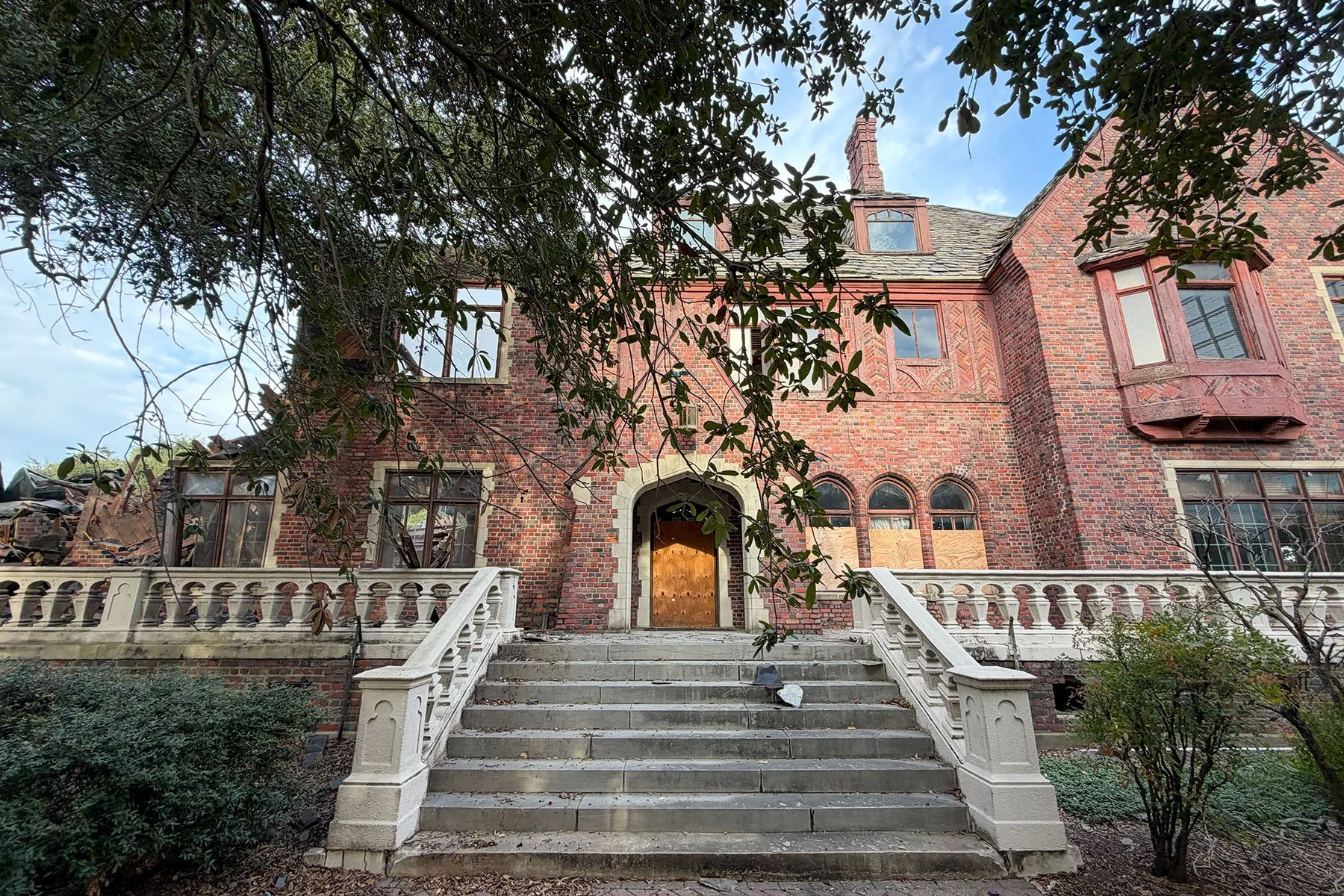
The Kirby Mansion (1894, 1926, James Ruskin Bailey) was demolished between Oct. 30 and Nov. 2, 2026. / photo by Jim Parsons
Built in 1894 and substantially rebuilt in 1926 for lumberman John Henry Kirby, the Kirby Mansion was a fine example of Tudor Revival architecture and the most substantial surviving home from Houston’s once-grand South End neighborhood. After the Kirby family’s ownership, the house served as the local Red Cross headquarters and later as private offices. In 1979, Preservation Houston recognized its restoration and reuse with one of our first Good Brick Awards.
The mansion was in use as office space until 2018, when longtime owner and attorney Philip Azar put it up for sale. When Ricardo Weitz bought the property and proposed replacing the house with a car dealership, we pointed to rehabilitation tax incentives and joined discussions about having the property designated a City of Houston landmark and how the mansion could fit into a new development. Weitz ultimately built his dealership elsewhere and put the mansion back on the market. We stayed in touch with brokers and walked the property with prospective buyers.
As the threat grew
By spring 2025, Buffalo Real Estate Partners was marketing the property. We proposed an open house to draw attention to the mansion and reach preservation-minded buyers, but the firm declined. We learned in summer 2026 that the property was under contract; the sale appears to have closed around Oct. 1.
The buyer was OB Texas Properties LLC, an entity linked to Omair Bashir, who develops Brake Time convenience stores and gas stations with his brother Usman. We alerted our members and the local press, offered to discuss rehabilitation incentives with Bashir, and met with Midtown Houston and the Downtown Redevelopment Authority to explore ways to support reuse.
In his only reply to us, on Oct. 6, Bashir expressed interest in meeting and said a few law firms were looking to lease the property. Our follow-ups went unanswered, as did repeated calls and emails to Greenberg & Company, the commercial real estate firm whose signs appeared at the property after the sale. Meanwhile, we continued tracking city and state records and found filings that pointed to plans for a gas station, convenience store and retail plaza on the mansion’s block. Although the gas station filings dated back months, Bashir’s Oct. 6 e-mail did not mention the proposal.
As work at the property raised the possibility of demolition, we voiced our concerns at an Oct. 21 City Council committee hearing and briefed Vonn Tran, Houston’s director of planning and development. We again asked to meet with Omair Bashir and sought access to document the house and save architectural features if demolition went ahead. Those requests went unanswered. We also emailed Council Member Carolyn Evans-Shabazz, whose district included the mansion, to request a meeting and reached out to Mayor John Whitmire’s office.
When demolition began
On Oct. 30, our staff went to the site after learning that demolition was under way. We checked city records and reported that crews had started without a demolition permit. By the time a Houston Public Works inspector issued a stop-work order, about half the house was gone. When work appeared to resume that afternoon, Preservation Houston Advisory Board member Minnette Boesel called Houston police, and our staff and city inspectors returned to the site. By day’s end, the city had cleared the owner to obtain a demolition permit and issued it, allowing work to proceed.
While part of the house still stood, we again asked the city and the owner for access. Archive Construction, an experienced architectural salvage and restoration firm, offered to recover hand-carved woodwork, imported tile, brick and other materials at no charge. A second team was ready to use LIDAR to create a three-dimensional record of the house. Neither team received permission to enter.
Our staff noticed dust in the air and no visible measures to control it throughout the demolition process. We asked the Texas Department of State Health Services to determine whether the mansion had been inspected for asbestos and whether the required demolition notice had been filed.
State investigators visited the site Nov. 2 in response to our request. Our staff met with them and documented the final stage of demolition. By late that morning, the mansion was gone.
What comes next
The demolition of the Kirby Mansion has made the need for earlier action clear. We want to bring community members, elected officials and others together to discuss how Houston can prevent another loss like this one. We’ll keep our members and the community informed as that work moves forward.
Nov. 3. We met with City of Houston staff to discuss the demolition and how we can work together before another historic building without landmark designation is threatened. The meeting opened the door to continued conversations about how city policy and preservation efforts could help protect these buildings.
Nov. 4. Executive Director Jennifer Kapral addressed City Council. “We are here as partners, and we want to collaborate with the city on proactive policy to protect our history,” she said. “Decisions about our built environment and our historic resources require thoughtful consideration before demolition. Because our historic resources are finite and shrinking, the city must implement systems that reflect the gravity and permanence of those decisions.”
Following the Nov. 4 City Council meeting, we began contacting council members to arrange meetings. As of Nov. 10, we’ve set meetings with the offices of Mary Nan Huffman (District G) and Willie Davis (At-Large Position 2). We’ll report when those meetings take place and share any developments. We had already emailed Council Member Carolyn Evans-Shabazz, whose District D included the Kirby Mansion, on Oct. 21. Her office did not respond until after demolition was complete; we are awaiting a response to schedule the meeting.
We have been in communication with Mayor John Whitmire’s office and welcome opportunities to work collaboratively with city leadership to strengthen historic preservation efforts and help protect Houston’s architectural heritage for future generations.
Dec. 1. We will hold a community town hall on Dec. 1, 2026, to discuss what Houston can learn from the mansion’s loss and hear your ideas for protecting other historic places. If you can’t attend, you can share your ideas through our online survey. We’ll use your feedback to shape what we bring to city leaders and share updates as the work moves forward.
Kirby Mansion FAQ
What was special about the Kirby Mansion?
The mansion, built in 1894 and remodeled in 1926 for lumber baron John Henry Kirby, was a rare surviving home from Houston’s historic South End. It served for decades as the local Red Cross headquarters and later found new life as offices. Its demolition was a loss for Houston, and we share the frustration of people who wanted to see it saved.
What happened to the mansion?
The property was sold around October 1 to OB Texas Properties, an entity connected with Omair Bashir. He and his brother Usman are the developers of Brake Time convenience stores/gas stations. The owners began demolition October 30, 2026, without proper city permits. About half the mansion had already been torn down when a City of Houston inspector issued a stop-work order. The owners then obtained permits and completed demolition on November 2. The mansion had no historic designation that would have given it protection against demolition.
Why wasn’t the mansion protected?
The Kirby Mansion had neither of Houston’s two landmark designations. A property owner or the Houston Archaeological and Historical Commission can start a Landmark nomination. For a Landmark outside a historic district, an applicant can seek a waiver if the city hasn’t approved demolition within the 90-day review period. Protected Landmark status offers stronger protection against demolition and requires the owner to apply.
In 2018, the commission considered a letter supporting the mansion’s preservation. However, the property never received Landmark designation, and no owner pursued Protected Landmark status. Preservation Houston helps property owners apply for Protected Landmark status, but the decision to apply rests with the owner.
What did Preservation Houston do to save the property?
We advocated for the mansion’s preservation beginning in 2018. Over the years, we talked with property owners and prospective buyers about ways to reuse the building and explored incentives that could help pay for rehabilitation. After the property changed hands in October, we contacted the new owner to discuss preservation and reuse. As the threat of demolition grew, we asked to document the building and salvage significant architectural features. Those requests went unanswered.
Why didn’t Preservation Houston buy the mansion?
We’re a small nonprofit that helps keep Houston’s historic buildings in productive use through education, technical assistance and advocacy. Buying and rehabilitating property is not part of our strategy. We believe our best role is to raise awareness about historic properties and help connect them with buyers and developers who have the vision and resources to bring them back into use. That work depends on current owners being willing to talk while there’s still time to consider alternatives. It also depends on owners following city and state permitting process.
What are you asking the city to do now?
We’ve begun talking with city officials about what Houston can learn from the loss of Kirby Mansion. We are exploring how the city can spot threats to historic buildings sooner and enforce permit requirements before damage is done. We’ll use what we hear from the community to help shape our recommendations to city leaders as talks continue.
Can Houston keep growing while preserving historic buildings?
Yes. Houston has plenty of examples of historic places finding new uses, from Sawyer Yards and the Eldorado Ballroom to POST Houston. The Kirby Mansion itself served as offices for decades after it stopped being a home. Reuse lets older buildings meet new needs while keeping the city’s history visible. We help owners and developers see what’s possible for these buildings, and our Good Brick Awards celebrate the projects that bring those ideas to life.
How can I help shape what happens next?
Take our short survey and join us for a community town hall on December 1, 2026. In the survey, tell us what Houston could do differently to protect historic places. At the town hall, we’ll discuss what Houston can learn from the loss of the Kirby Mansion and hear your ideas for protecting other historic places. We’ll use feedback from both to shape the recommendations we take to city leaders and share updates as the work moves forward.
What should I do if I’m worried about a historic building in my neighborhood?
Contact Preservation Houston as soon as you notice a change that concerns you — and alert your neighborhood association as well. Send the address, what you’ve observed and when, and any photos or public notices you have. Early information gives us more time to understand what’s happening and see whether we can help.