
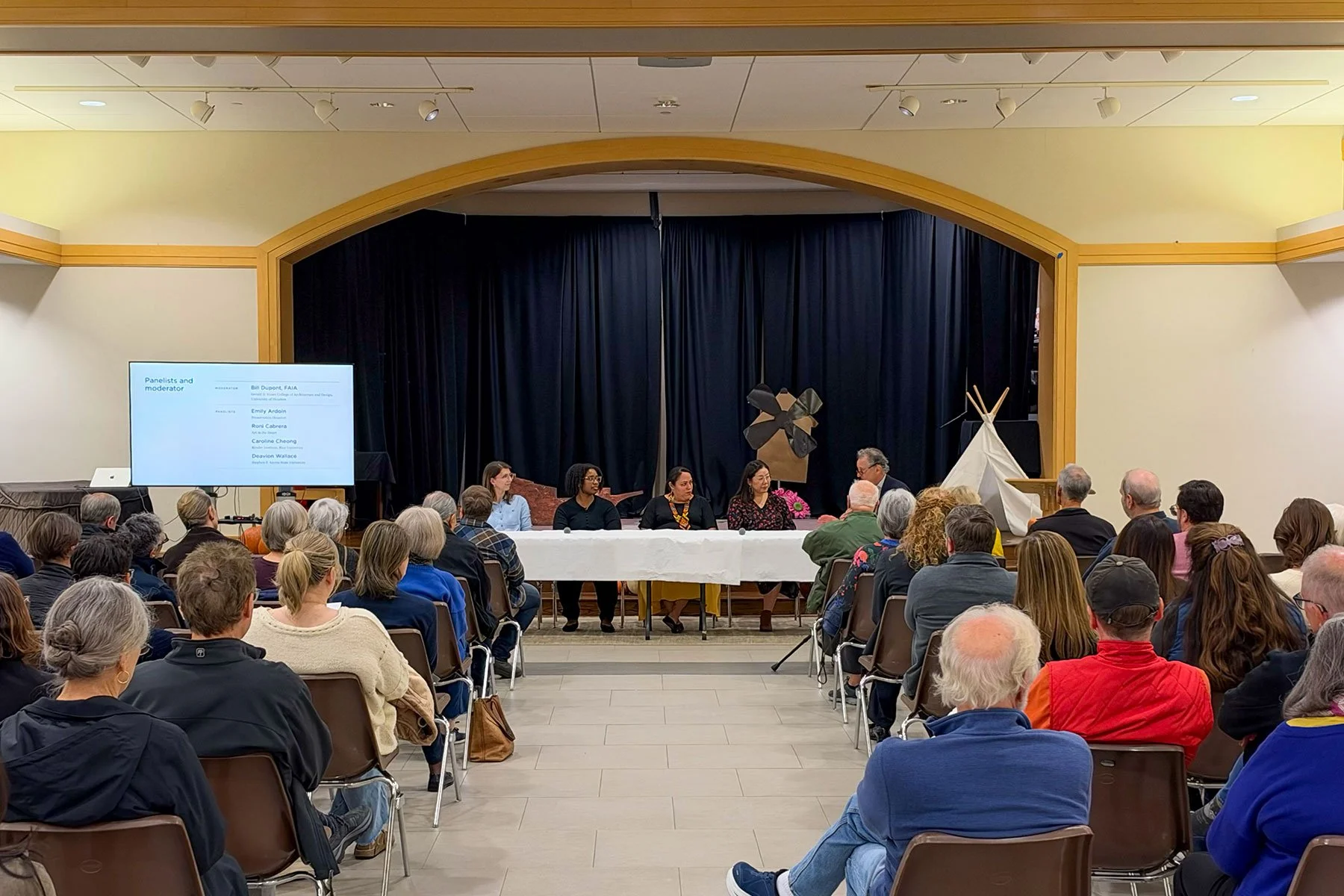
About 100 people gathered Nov. 17 at St. Paul’s United Methodist Church for A City Worth Remembering, a panel presented by Preservation Houston, Houston Design Collaborative and Houston Mod. / photo by Jim Parsons
Roni Cabrera has lately found herself painting murals of ghosts. Her subjects are buildings that have disappeared from Houston's landscape, memorials to neighborhood anchors that have quietly vanished. Years ago, watching a historic church demolished to make way for a gas station helped turn her into a preservation advocate. More recently, she rallied neighbors to fight for the Granada Theater in her Eastex-Jensen neighborhood, envisioning it as a hub for young artists and local performances. Though the theater was ultimately demolished, the campaign drew new attention to a community often overlooked by the city.
“I believe spaces hold power and energy and history in them,” Cabrera said during a panel discussion Nov. 17. When those buildings are leveled, all that remains for the next generation may be paint on a wall.
That tension — between a city famous for reinvention and communities fighting to keep their physical anchors — drew about 100 people to St. Paul’s United Methodist Church in the Museum District for A City Worth Remembering, a forum presented by Preservation Houston, Houston Design Collaborative and Houston Mod. Following the recent demolitions of buildings including the Granada Theater and Kirby Mansion, five advocates, researchers and community leaders considered what preservation might accomplish in a changing city.
“When we think about historic cities around the world, when we think about buildings demolished, we think of them being replaced with iconic symbols of modernity,” said Caroline Cheong of Rice University’s Kinder Institute. In Houston, she noted, “they’re not symbols of modernity” — they are gas stations and strip malls.
Recognizing the value of familiar commercial buildings is part of a broader shift in preservation. Emily Ardoin, Preservation Houston’s preservation services director, recalled how Bellaire Chinatown changed her view of the built environment. Its buildings had taken on new meaning through the businesses, traditions and communities that made them their own. The experience shook her out of her “architectural snobbery.”
Deavion Wallace, a graduate student researching Houston’s original Chinatown, encountered a related lesson. Buildings she considered significant did not necessarily hold the same importance for the people whose history she was studying. Preservationists, she realized, cannot impose their priorities on a neighborhood; they must listen to what residents value. Architecture tells part of a building’s story. The rest belongs to the people who adapted it, occupied it and made it part of their lives.
“Houston is a city of industry and private sector motivations. Preservationists need to be better about speaking the language of businesspeople.”
associate director of community engagement
Center for Housing and Neighborhoods, Kinder Institute
Recognizing what a place means, however, is only part of the challenge. The harder question is how to ensure both the place and its community have a future. Houston’s older neighborhoods face rising property values and the displacement of longtime residents. A historic building may survive even as the people who gave it life are priced out of the surrounding blocks.
Cheong argued that preservationists cannot rely on sentiment alone. “Houston is a city of industry and private sector motivations,” she said. “Preservationists need to be better about speaking the language of businesspeople.” Historic designation can protect buildings, but it cannot by itself address the economic pressures on residents. Community land trusts and tax policy reforms, she suggested, could help longtime residents remain in changing neighborhoods.
“Preservationists are some of the most solution-oriented people that I’ve ever met,” Ardoin said. “We like to say yes.”
Older buildings can be practical assets for a growing city. Ardoin pointed to closed public schools as potential neighborhood anchors, following the example of rehabilitated places such as the Eldorado Ballroom and Riverside Hospital. Bill Dupont, who leads the University of Houston’s historic preservation program, suggested that historic buildings could also serve as community centers and places of refuge during hurricanes and other emergencies.
The environmental case is equally compelling. Ardoin recalled watching valuable architectural materials reduced to debris during the demolition of the Kirby Mansion. Reusing buildings can conserve resources, reduce waste and retain the established landscapes that contribute to a neighborhood’s sense of place.
Yet making a case for preservation also requires helping people imagine possibilities they may never have seen realized. For Cabrera, the Granada Theater represented an opportunity to bring cultural activity and economic life to Eastex-Jensen. But successful examples of adaptive reuse remain unfamiliar in many neighborhoods.
“When you haven’t seen something done in your space, it’s hard to imagine that it’s possible,” she said.
The panelists emphasized the need to bring more people into decisions about what Houston preserves, particularly younger residents and communities whose experiences have not always been reflected in preservation efforts. Wallace noted that physical history can offer a sense of continuity for a generation accustomed to rapid change. Cheong urged preservationists to welcome perspectives that challenge their assumptions.
Houston still lacks a comprehensive survey of its historic places, leaving decisions about their future too often to be made one property at a time, under the pressure of an immediate threat. But the city’s reputation for reinvention need not be the enemy of preservation. Its unconventional character could make it a laboratory for new approaches.
Asked what they hoped Houston might look like half a century from now, the panelists imagined a city where more of its history remains visible, neighborhoods retain meaningful connections to their past and preservation reflects a wider range of experiences.
“Preservation says more about the generation that’s doing the preserving than the generation being preserved,” Ardoin said, adding that she hopes Houston will eventually be known as “the city that used to tear everything down.”
Dupont encourages his students to think in an even longer arc — a 400-year window — considering how the demolition and preservation decisions made today will be understood by people they will never meet. Preserved places, he suggested, are messages sent into the future.
“We are natural time travelers,” Dupont said. “We travel into the future as much as into the past.”